


August 5, 2014 9:00 pm JST
EMMA LARKIN, Contributing writer
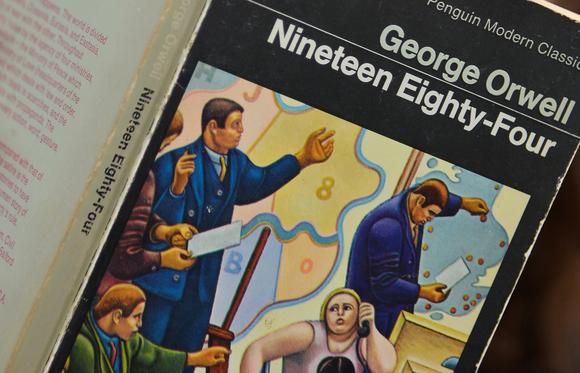
George Orwell’s classic novel “Nineteen Eighty-Four,” which describes a surveillance society, was first published 65 years ago. © Reuters
BANGKOK — It is a Saturday afternoon and I am wandering the polished hallways of Paragon, one of Bangkok’s most luxurious shopping malls, searching for signs of protest. When a frenetic series of camera flashes light up the atrium windows, I hurry down to the front of the mall, toward a fast-growing throng of journalists, photographers and policemen. Pushing my way through the gawking crowd, I find the source of the commotion: A solitary protester. He sits alone amid the hubbub, solemnly holding aloft a copy of George Orwell’s novel “Nineteen Eighty-Four.”
In the wake of the May 22 military coup in Thailand, hundreds of people came out to demonstrate against the overthrow of a democratically elected government. But the country’s new rulers, the National Council for Peace and Order (NCPO), proved astoundingly efficient at routing out opposition — within weeks, the number of anti-coup protesters had dwindled to a mere handful. As Thais who oppose the coup grapple with the ever-decreasing space available to dissenters, Orwell’s dystopian novel serves as both a cautionary tale and a handbook for defiance.
The use of “Nineteen Eighty-Four” as a symbol of protest started among a group of young activists who organized public book readings to express their objection to the coup. There was nothing illegal about their silent gatherings; they never lasted longer than an hour and the number of participants in any one group was capped at four (martial law forbids public assemblies of more than five people). But even these small-scale events soon became impossible to conduct without provoking the ire of the NCPO.