


HARRY W.S. LEE 09.02.14
Guang Niu/Getty Images
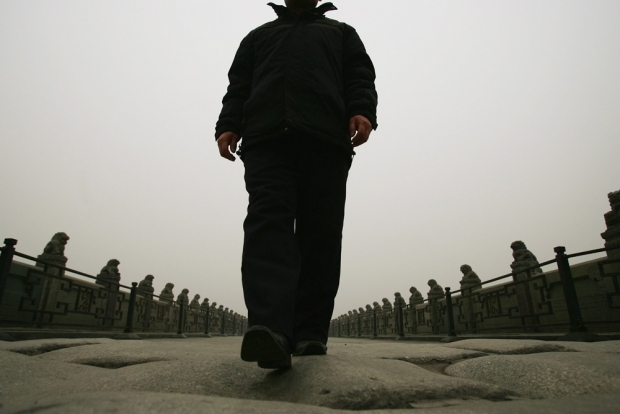
A man walks on the Marco Polo Bridge in Beijing. On July 7, 1937, Japanese troops attacked the bridge, also known as Lugou Bridge, at the outskirts of Beijing.
When we see young Chinese people at a state event collectively chant, “Do not forget national humiliation and realize the Chinese dream!” we may be tempted to dismiss it as yet another piece of CCP propaganda. But we may also find ourselves pondering what “national humiliation” has to do with “the Chinese dream.”
This was precisely how the 77th anniversary of the Marco Polo bridge incident—the battle that in China symbolically marks the beginning of what is known as the War of Resistance Against Japan—concluded outside of Beijing in July. It was reportedly the largest state commemorations of the incident. President Xi Jinping gave a speech castigating Japan for its “historical revisionism” on the matter of its actions in China during World War II. “Chinese people who have sacrificed … will unswervingly protect, with blood and life, the history and the facts,” he declared. Earlier this month, on the anniversary of Japan’s defeat in World War II, Prime Minister Shinzo Abe declined to mark the day with a visit to the Yasukuni Shrine and instead opted to send a ritual offering, a conciliatory gesture. But it backfired; Xinhua complained that Japan had “once again embarked on a precarious path and blatantly challenged the postwar international order of peace.”
In 2008, the Marco Polo Bridge incident was not commemorated so as to accommodate Hu Jintao’s visit to Japan the next year to sign an agreement on gas field development around the Diaoyu/Senkaku islands. But state evocations of China’s “Century of Humiliation”—the central message of the CCP’s patriotic education—appear to be back on full volume under Xi’s regime, and louder than ever. Japan’s purchase of the Diaoyu/ Senkaku islands, textbook controversies, Yaskuni Shrine visits, the re-examination of the 1993 Kono Statement which acknowledged the Japanese Imperial Army’s involvement in coercively recruiting “comfort women” during World War II, and on-going attempts to reinterpret the constitution are all galling provocations from China’s perspective—and understandably so. But China’s reactions go beyond condemnation or calls for international arbitration. Its leaders are actively stirring up nationalist fervor for political gain.
For detail please visit here