


NICHOLAS BEQUELIN, SEBASTIAN VEG, DAVID SCHLESINGER, FU HUALING, WONG HOW MAN 10.01.14
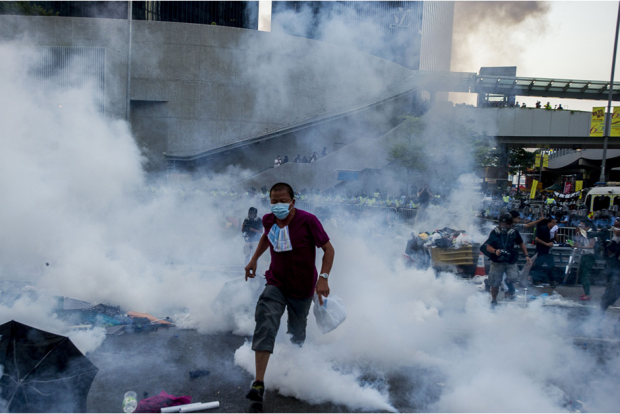
Xaume Olleros/AFP/Getty Images
A pro-democracy demonstrator runs as police fired tear gas towards protesters near the Hong Kong government headquarters on September 28, 2014. Police fired tear gas as tens of thousands of pro-democracy demonstrators brought parts of central Hong Kong to a standstill on September 28, in a dramatic escalation of protests that have gripped the semi-autonomous Chinese city for days.
Over the past week, tens of thousands of Hong Kong people have occupied the streets of their semi-autonomous city to advocate for the democratic elections slated to launch in 2017. The pro-democracy protestors have blocked major roads in the downtown area and police fired teargas into crowds on Sunday. On Wednesday, the standoff entered a new phase. — The Editors
Thursday, October 2, 2014 – 12:49pm
Nicholas Bequelin
The Hong Kong protests have just entered their third act, with C.Y. Leung, the Chief Executive, announcing minutes before a deadline set by student protestors, that the government would meet the main protest organizers “to discuss constitutional developments.” While Leung’s announcement defuses the risks of an immediate escalation of the confrontation, it is not clear if the government is genuinely motivated by a desire to find common ground with the protestors, or is instead employing a delay tactic in the hope that the momement peters out.
I, personally, have few doubts that the leadership in Beijing would have little hesitation in using lethal force against its own people if they felt the Chinese Communist Party’s grip on power was slipping. But the current situation in Hong Kong is still a long way from that crossroads, and the fact that the Hong Kong government finally acceded the initial demand of the students—a face-to-face meeting—reflects it.
The nature of the confrontation in Hong Kong is in essence a question of autonomy: how much, or how little, genuine autonomy can the territory maintain, now that it has returned under Chinese sovereignty. As Sebastian Veg notes below, the protest movement is not a frontal challenge to the Party’s monopoly on power in Mainland China, nor does it seek to challenge China’s sovereignty on the territory. But a hardline response from the authorities could change that.
Around the world, tensions between actual or nominal autonomous territories and their respective sovereign power about the extent they are allowed to self-govern are part and parcel of any autonomy arrangement that has—for historical or cultural reasons—come into being. Hong Kong is no different.
At the moment, the student-led protest movement is voicing a very simple, compelling demand: that Hong Kong be granted what it has been promised, “a high degree of autonomy,” “no change for fifty years,” and “one country two systems.” But since the handover in 1997 the Hong Kong government has failed to do what the Communist Party in China has been so adept at since the bloody suppression of the 1989 democracy movement: respond to social demands before their turn into political ones.
As a result, long accumulated frustrations about local governance in Hong Kong—including trying to keep Mainland China authoritarianism and utter disrespect for the rule of law—have crystalized into demands for something that Beijing never intended to give to its Special Administrative Region: genuine democracy.
Precisely because the majority of the Hong Kong public understands that the prospect of a one-party dictatorship granting democracy to a segment of its population is close to nil, it is not clear that the center of gravity of public sentiment overlaps with the demands of the students and Occupy Central.
Beijing and the Hong Kong government are counting on this to drain out support for the protest movement, and stick to the uncompromising arrangement that the National People’s Congress has imposed for the election of the Chief Executive: “you are free to vote in any of the candidates we have chosen for you.”
The resulting situation is volatile. Two editorials from the People’s Daily published in recent days have made clear that at the moment Beijing is still hoping it can steamroll opposition in Hong Kong and close the chapter of trying to fulfill its obligation under Article 45 of the Basic Law to set a system by which the Chief Executive is designated “by universal suffrage upon nomination by a broadly representative nominating committee in accordance with democratic procedures.” (Article 45 of the Basic Law.)
It could then move to the next item on the Basic Law: the dreaded Article 23 anti-subversion law, which would almost certainly result in a dramatic decrease of political and civil liberties as well as freedom of information in the territory.
For detail please visit here