


 FEB. 2, 2015
Credit Jing Wei
BEIJING — In early November, when Beijing played host to the Asia-Pacific Economic Cooperation meeting, city officials closed hundreds of factories and forced millions of vehicles off the roads to clear the soupy gray smog that normally blankets the sky. But one day the pollution level soared, with data from the United States Embassy showing an index reading six times the World Health Organization’s safe daily limit. Seeking their last course of action, the Chinese officials summarily removed the American statistics from smartphone apps and Chinese websites.
Reading the news while on my university campus in the United States, I joked with friends in Beijing that it had reminded me of a proverb we learned in elementary school that tells the story of a man who tries to steal a large copper bell from a house. To carry it away, he decided to break it into pieces with a hammer, but feared the noise might alarm its owner. So he plugged his ears, believing it would muffle the sound for other people.
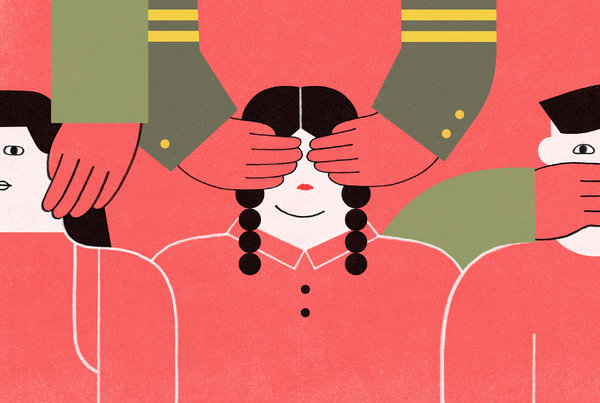
The element of self-deception in China’s attempt to control information has always invited mocking skepticism. In 2000 President Bill Clinton famously compared Chinese Internet censorship to “trying to nail Jell-O to the wall.” But as the ensuing years have proved, Chinese censors’ commitment to this seemingly hopeless enterprise has created a dire reality that imprisons each of its citizens.
Last year, several non-Chinese social media apps, including Instagram and Line, fell under the censors’ blade, joining a growing list of foreign services, such as Facebook and Twitter, that are inaccessible in China. Google, having long been in the crosshairs of the Chinese authorities, saw its Gmail service in China disrupted in late December. In recent weeks, the authorities have disabled popular virtual private networks — technical loopholes that many residents had used to access online content beyond the Great Firewall.