


JULY 28, 2014
BY ABIGAIL DEUTSCH
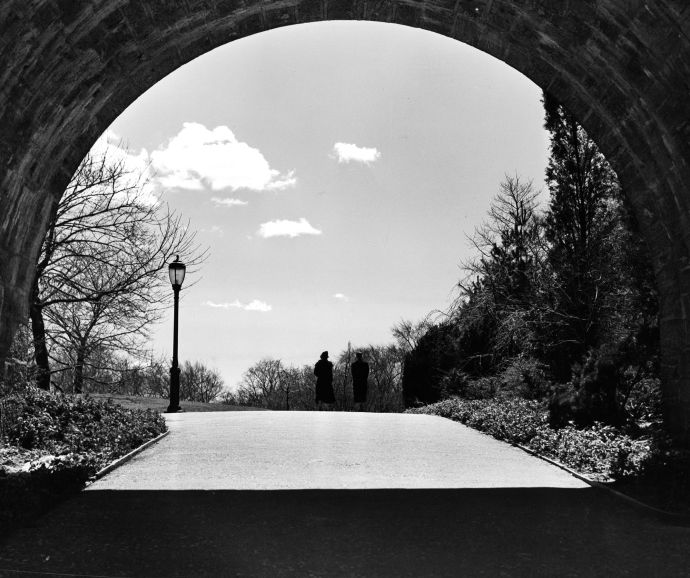
Fort Tryon Park, 1955.
CREDIT PHOTOGRAPH BY GEORGE ENELL/ARCHIVE PHOTOS/GETTY.
During a recent stroll in Fort Tryon Park, in upper Manhattan, I spotted a green placard emerging from a tuft of purple flowers. Its white letters read:
Let no one say, and say it to your shame,
That all was beauty here, until you came.
I was enchanted to find a park sign filled with poetry rather than the usual mishmash of information, rules, and thinly veiled threats. And such doting poetry: the park, the sign implied, had not been entirely beautiful without me. (I never mind a compliment, even when it comes from an inanimate object.)
The lines were unattributed, and, like the recipient of a note from a secret admirer, I yearned to discover the writer’s identity. But, to my surprise, Google didn’t name an author—no single author, anyway. Various Web sites attribute the phrase to a British schoolmaster, to the Lancashire Evening Post, and to Rudyard Kipling. Travellers report having spotted it on plaques in Britain, the United States, Portugal, and Tasmania. The sentence had its day on the silver screen—a placard appeared in the 1942 horror flick “Cat People”—and even in literary studies. Chastising imprecise speakers of English, C. S. Lewis modified the phrase as follows: “Let no one say, and say it to your shame / That there was meaning here before you came.” Yet I could identify no source; the couplet appeared to have always existed, everywhere, like God.