Author Archives: editor

No. 14 Yu ZHANG: Sixty-four Years of Literary Inquisition Surpasses Two Millennia

–Author’s Preface

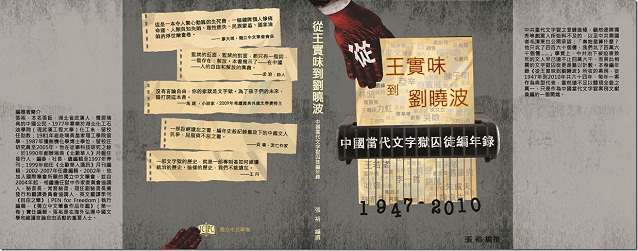
cover-2014

In Chinese dictionaries published since the founding of the People’s Republic of China (PRC) in 1949, the definition of Literary Inquisition is restricted to “the rulers of olden times”; at the very least, it is a relic of the past, occurring no more recently than a century ago, mainly during the Ming and Qing dynasties. In the Mandarin Dictionary published by the Ministry of Education of the Republic of China (ROC, Taiwan), Literary Inquisition is defined as occurring in the “era of absolute monarchy”, precluding its existence in the Republic era. A revised edition has amended the definition to read, “During the autocratic era, criminal cases arising from the written word”. This last definition is the common usage adopted by contemporary Chinese literature, and also for this book.

Continue reading

No. 14 TIENCHI MARTIN-LIAO: Shocking Stories of Life and Death

–Publisher’s Afterword

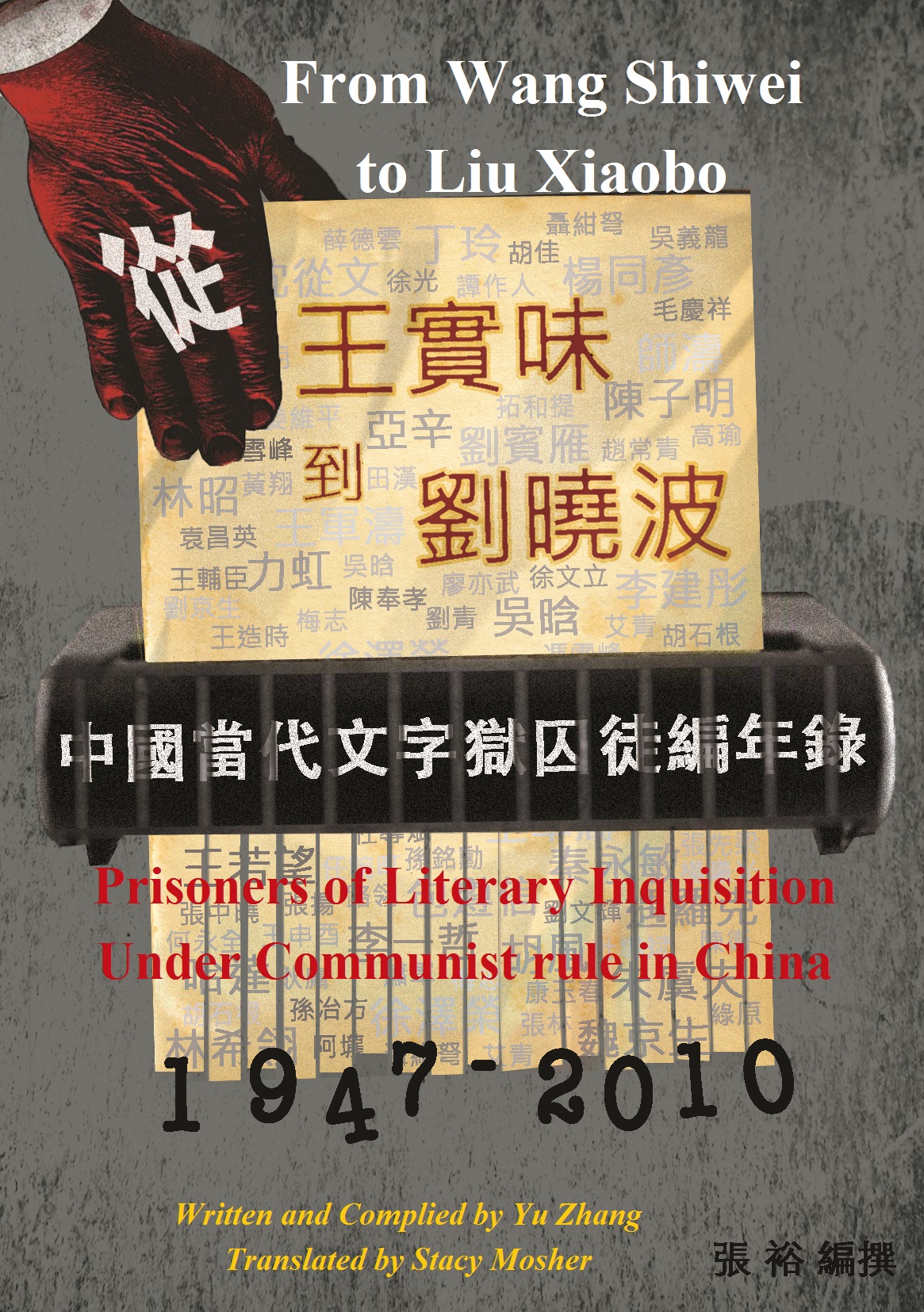
From Wang Shiwei to Liu Xiaobo: Prisoners of Literary Inquisition under Communist Rule in China

Wenziyu-coverThis shocking book of life and death depicts a floating world of personal tragedy, conscience gone adrift, the loss of reason, a people’s shame and a nation’s fall. Continue reading

ICPC Statement on PEN International Day of Imprisoned Writers

For Press Release
15 November 2014

Chen Shuqing Honored the Liu Xiaobo Courage to Write Award and 17 Writers Adopted as Honorary Members

Chen ShuqingThe Independent Chinese PEN Centre (ICPC) has honoured Mr. CHEN Shuqinqing, its member and an imprisoned writer in China, this year’s Liu Xiaobo Courage to Write Award for his long-term tenacity and courage in writing despite the threat of imprisonment. In addition, ICPC have adopted seventeen of writers imprisoned in China as its new honorary members, including WANG Bingzhang, GARTSE Jigme, WO Zhongxiao, WANG Jianmin, SHEN Yongping, TANG Jingling, WANG Qingying, YUAN Chaoyang, XU Zhiqiang, HUANG Zerong, GUO Yushan, KOU Yanding, HUANG Kaiping, ZHANG Miao, CHEN Kun, CHEN Yongzhou and JIANG Lijun.

Continue reading

East German officer Harald Jaeger explains why he opened the Berlin Wall

November 8, 2014
Erik Kirschbaum

Balloons mark anniversary of Berlin Wall
Thousands of balloons, tracing the path where the former Berlin Wall once stood, are released into the air, in a symbolic gesture marking the collapse of the Cold War barrier, 25 years on.
Berlin balloons soar away in tribute to fall of the wall

bolin1
East and West German citizens celebrate as they climb the Berlin wall at the Brandenburg Gate on November 9, 1989. Photo: Reuters
Continue reading

An Internet Where Nobody Says Anything

Ilham Tohti’s unjust fate says much about the Chinese Communist Party’s dark vision for the web’s future.

BY DAVID WERTIME SEPTEMBER 25, 2014

Here is what a court in Urumqi, the capital of China’s western Xinjiang region, concludes Ilham Tohti, a balding, thick-set, 44-year-old professor, did: “Using ‘Uighur Online’ as a platform, and taking advantage of his role as a university professor,” Tohti “spread separatist notions” and “bewitched and coerced” seven of his students to join into an eight-person, web-powered splittist clique with international reach. Here is what Tohti, by all appearances, actually did: He created and maintained a Chinese-language website, called Uighur Online, that provided a bridge between China’s Han majority and its Uighur minority, a Turkic-language-speaking, predominantly Muslim group that mostly lives in Xinjiang and has an uneasy history of coexistence with the growing number of Han who live among them, one marred by violent clashes. Continue reading

Another Zhejiang Democracy Activist in Custody for “Subversion”

September 15, 2014

Less than a month following the August 13 arrest of Lü Gengsong(吕耿松) on “subversion of state power,” another core member of the China Democracy Party’s Zhejiang Committee, Chen Shuqing (陈树庆), was detained on the same charge.

Chen’s wife, Zhang Donghong (张东红), told HRIC that at 3:30 p.m. on September 11, Domestic Security officers from the Hangzhou Public Security Bureau conducted a search at the couple’s home, and took away a desktop computer, a mobile phone, documents, and some badges, without leaving a list of the confiscated items.

Another source told HRIC that Chen himself was taken away by Domestic Security officers at around 1:00 p.m. the same day. The detention notice from the Hangzhou Public Security Bureau lists 6:00 p.m. as the time of Chen’s detention.

Previously, Chen served a four-year sentence for “inciting subversion of state power” in connection with his role in organizing the China Democracy Party’s Zhejiang Committee and articles he wrote calling for democratic reform. He was released in September 2010 and soon resumed his activism. In November that year, he was among six individuals who applied to the Hangzhou Public Security Bureau for a permit to hold a demonstration to call for democratic reform. In 2014, he signed a joint public statement urging the release of detained individuals, and published an account of Lü being denied access to his lawyer while in detention.

Chen was a participant in the 1989 student movement, and began his pro-democracy activism in 1995. He became involved in the preparatory work for organizing the China Democracy Party in 1998, for which involvement he was detained for four months in 1999.


HRiC,http://www.hrichina.org/en/press-work/hric-bulletin/another-zhejiang-democracy-activist-custody-subversion

Veteran Chinese Opposition Activist Held on Subversion Charges

2014-07-10

china-Luu_Gengsong305.gif

An undated photo of activist Lu Gengsong.

Photo courtesy of Lu Gengsong’s family

Authorities in the eastern Chinese city of Hangzhou have once more detained a veteran pro-democracy activist on suspicion of subversion, his wife and rights groups said.

Activist and member of the banned opposition China Democracy Party (CDP) Lu Gengsong was criminally detained by Hangzhou police on Monday on suspicion of “incitement to subvert state power.”

However, his wife said the move was likely a form of retaliation for Lu’s advocacy work on behalf of ordinary people with grievances against the ruling Chinese Communist Party.

“Lu Gengsong came to see me at my workplace at around 8:00 p.m. [on Monday], and the police took him away as he was coming out,” Lu’s wife Wang Xue’e told RFA.

“The police didn’t give us a reason.”

According to a copy of the police detention notice seen by RFA, Lu is currently being held at the Hangzhou detention center.

Wang said more than 20 officers had then searched the couple’s home, seizing a computer and two cell phones.

“The Hangzhou police didn’t send the notification of criminal detention to us until Tuesday morning,” Wang said.

The charge against Lu, 58, was listed as “incitement to subvert state power,” she added.

She said she planned to hire top rights attorney Mo Shaoping to defend Lu.

“That’s what Lu Gengsong told the state security police, and they gave me the message,” Wang said.

Recent posts

Meanwhile, fellow CDP activist Chen Shuqing said Lu’s detention could be linked to recent posts he had made online regarding rampant official corruption.

“My guess is that this something to do with articles Lu Gengsong posted online in recent days about corrupt officials, and also his reporting on the cases of petitioners in Jiangsu province,” Chen said.

Chinese president Xi Jinping has launched a nationwide anti-graft crackdown, targeting high-ranking “tigers” and low-ranking “flies,” since coming to power in November 2012.

But the party regards any popular involvement in the anti-corruption campaign as highly sensitive and potentially threatening, and has sentenced a number of activists to jail for calling on officials to reveal their wealth.

Meanwhile, Sichuan-based rights activist Huang Qi said Lu had done a great deal of advocacy work on behalf of disadvantaged people in recent years.

“Starting in 2005, Lu Gengsong began working with us at Tianwang on some rights-defending activities,” Huang said. “He was then locked up on a trumped-up charge after he annoyed some people in the local government.”

“The authorities are using his online writings about democracy and his membership in the CDP as an excuse,” Huang said. “The authorities make a habit of interrogating him and searching his home under suspicion of incitement to subvert state power.”

Previous harassment

Lu was last detained under similar charges last November. His home was also searched and computers confiscated at that time, although he was later released under close surveillance.

According to the New York-based group Human Rights in China, the couple’s home has been under 24-hour surveillance since February, and Lu has been restricted to his home with limited freedom of movement.

Lu was sentenced by a Hangzhou court to four years’ imprisonment for “incitement to subvert state power” in February 2008, in a trial that Wang said took about 15 minutes.

A history graduate from eastern China’s Zhejiang University, Lu taught at a police college before being expelled in 1993 because of his pro-democracy activities.

Since then, he has published several books, and is best known for “A History of Chinese Communist Party Corrupt Officials,” published in Hong Kong in 2000.

The CDP was banned in 1998 and several of its founder members sentenced to lengthy jail terms for subversion the same year.

Rights record

Beijing has repeatedly hit out at international concern over its human rights situation, saying that only the Chinese people have the right to speak out on the subject.

But the authorities repeatedly detain and harass any activists who try to do so.

China signed the U.N. International Covenant on Economic, Social and Cultural Rights and the International Covenant on Civil and Political Rights in 1998, ahead of its bid to host the Olympics, but neither treaty has been ratified by its parliamentary body.

Reported by Gao Shan for RFA’s Mandarin Service, and by Grace Kei Lai-see for the Cantonese Service. Translated and written in English by Luisetta Mudie.

China detains writer Tie Liu for ‘provoking trouble’

PLA soldiers stand guard at a metro station as visitors arrive at the site of the World Expo 2010 in Shanghai on 20 April 2010.Chinese authorities said they detained Mr Huang for “picking quarrels and provoking trouble”

Chinese writer Huang Zerong, also known as Tie Liu, has been detained by police allegedly for writing articles critical of a senior official.

Police arrested Mr Huang, 81, at his Beijing home early on Sunday morning.

Mr Huang’s wife was later told he had been detained for “picking quarrels and provoking trouble”.

She said he had written online articles which criticised Communist Party propaganda chief Liu Yunshan for restrictions of press freedom.

She told the Associated Press that her husband’s medical carer had also been detained on the same charge, with no reason given as to why.

The South China Morning Post reported that Mr Huang served 23 years in prison when he was in his twenties for being a “rightist” during Mao Zedong’s crackdown on liberals.

The Communist Party eventually cleared his name in 1980.

Picture of Yang Maodong, also known as Guo Feixiong, presented at a hearing of a House Foreign Affairs Committee subcommittee in Washington, DC, on October 29, 2013.Activist Yang Maodong, also known as Guo Feixiong, is currently detained for allegedly disturbing public order
In this 7 April 2010 file photo, Gao Zhisheng, a human rights lawyer, gestures during an interview at a tea house in Beijing, China.Human rights lawyer and dissident Gao Zhisheng allegedly suffered abuse while in jail

Widespread crackdown

Mr Huang’s arrest comes a week after a court in Guangzhou postponed the trial of prominent human rights activist Yang Maodong after he instructed his lawyers to boycott proceedings.

Mr Yang, who is also known by his pen-name Guo Feixiang, has claimed that the trial is illegal and improper. He is accused of disturbing public order.

Chinese authorities have mounted a widespread crackdown on dissenters in recent years.

Dozens of activists and government critics are said to have been targeted, with many detained, and some prosecuted on broad public order charges.

Last month, well-known Chinese dissident Gao Zhisheng was released having allegedly suffering physical and psychological abuse in jail.

BBC

http://www.bbc.com/news/world-asia-china-29204874